Poly-Soil Greening | The Forefront of Civil Engineering Maintenance Supporting the Future of Solar Power Generation
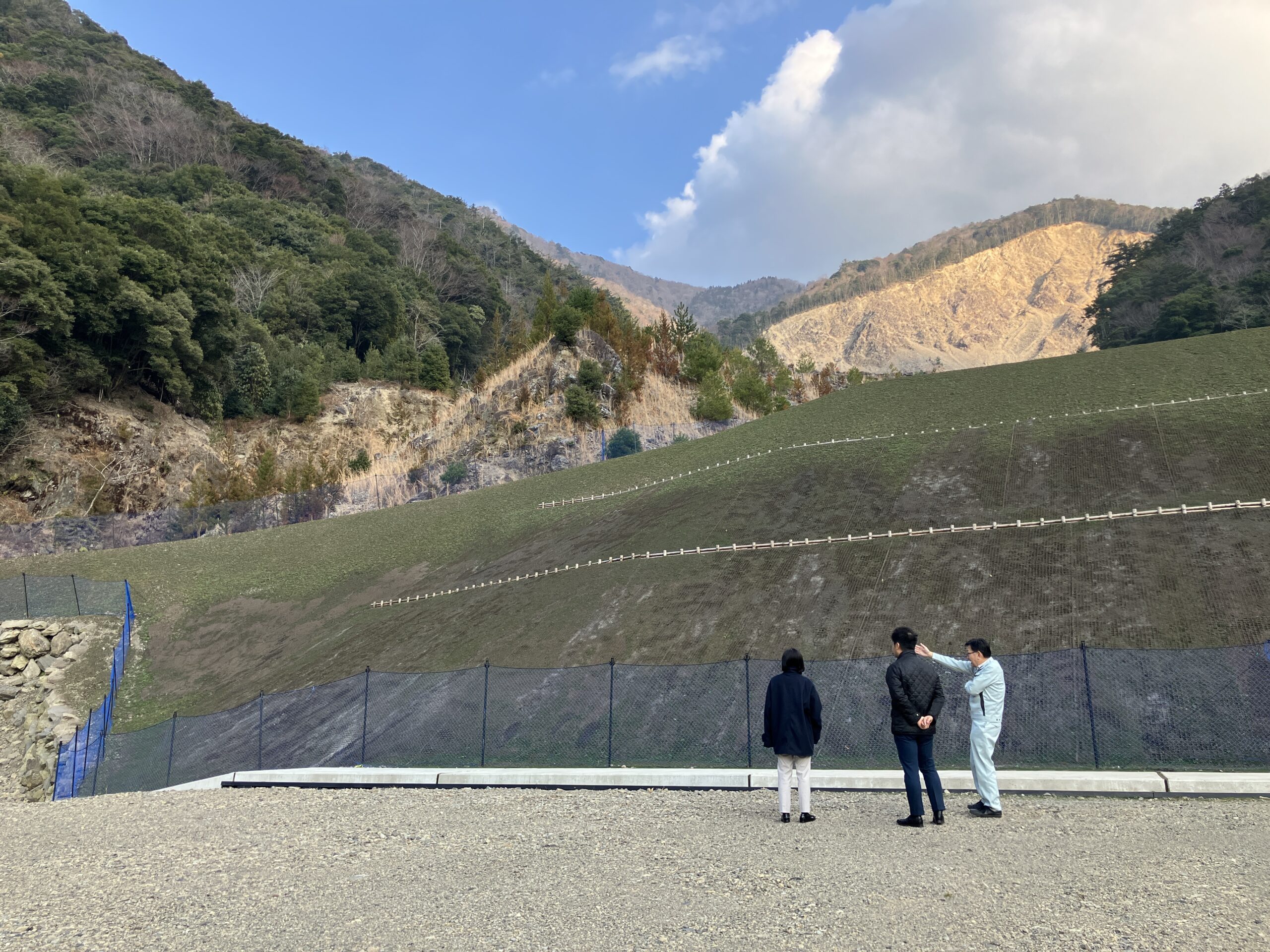
In recent years, many solar power plants have reached their tenth year of operation. To maintain these power plants as infrastructure over the long term, maintenance of the land itself—civil engineering—is just as vital as electrical equipment. Particularly in environments susceptible to heavy rains and extreme weather, preventing soil erosion and stabilizing the ground are top priorities.
“Greening” is attracting attention as one method to resolve these issues. Shizen Operations recently implemented Poly-Soil Greening to prevent sediment discharge at a power plant in Kyushu. This method is superior to general greening in terms of speed of effect, stability, ease of construction, and cost-effectiveness, and we view it as an effective option for civil engineering maintenance.
In this article, we spoke with Mr. Tomoya Hashimoto, Representative Director of Maruhachi Doken Co., Ltd., which provides Poly-Soil Greening, about the background and effects of this method.
When Slope Protection Specialists Maruhachi Doken Discovered Poly-Soil: “The Immediate Results in Turbid Water Control Amazed Us”
— First, please tell us about your company.
Maruhachi Doken Co., Ltd. is a sixty-four-year-old firm specializing in slope works and sediment management. Our portfolio is roughly 60–70% public works and 30–40% private sector. While based in Mie Prefecture, we operate nationwide. We pride ourselves on handling highly specialized construction methods that only a few companies in Japan can execute.
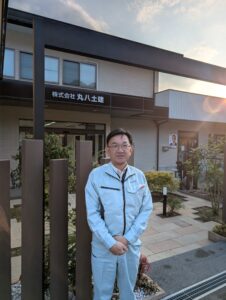
Tomoya Hashimoto, Representative Director of Maruhachi Doken
In addition to Poly-Soil Greening, we offer Poly-Soil Topsoiling, which creates a vegetation base on bedrock or hard soil to improve the landscape. We also use the Stand Drive (SD) Method, which reduces costs and timelines by eliminating the need for temporary scaffolding, and Porous Concrete Spraying, to protect river revetments, dam reservoirs, and slopes with spring water while allowing water permeability.
— How did you first encounter the Poly-Soil Greening method?
It was back in 2017. A solar power plant in Matsusaka City approached us about preventing turbid water and soil runoff. Local farmers and prefectural and city governments were demanding immediate improvements due to environmental concerns.
After exploring various countermeasures, we finally discovered Poly-Soil Greening, which has been successfully used in Okinawa to prevent red soil runoff. We decided to run a test application after our proposal.
Three days after the application, the area was hit by heavy rain. I rushed to the site, worried, but I found zero turbid water. The runoff was crystal clear. I remember being shocked—it was completely different from any conventional method.
We eventually treated over 2,000 square meters of land with this method. Within a month, the area was lush with green, and soil erosion and turbid water runoff were eliminated. Following this success, we have built a track record across Japan. Furthermore, we report our results to Ryuseki Construction Co., Ltd. in Okinawa, the developer of the Poly-Soil Method. Together, we are actively promoting this greening technology.
Three days after the application, the area was hit by heavy rain. I rushed to the site, worried, but I found zero turbid water. The runoff was crystal clear. I remember being shocked—it was completely different from any conventional method.
We eventually treated over 2,000 square meters of land with this method. Within a month, the area was lush with green, and soil erosion and turbid water runoff were eliminated. Following this success, we have built a track record across Japan.
Furthermore, we report our results to Ryuseki Construction Co., Ltd. in Okinawa, the developer of the Poly-Soil Method. Together, we are actively promoting this greening technology.
Why Poly-Soil Greening? Speed, Stability, Ease of Construction, and Cost-Effectiveness
— What are the primary advantages of Poly-Soil Greening?
The primary advantage is how quickly it takes effect. The surface hardens in just one day in summer and three days even in winter, preventing soil displacement. It specifically targets and suppresses gully erosion—the deep grooves typically seen in untreated soil. At this point, the ground is already protected against being washed away by moderate rain.Because the sprayed base contains seeds and fertilizer, the area can be fully greened in a month under the right conditions.
Naturally, during winter, the seeds will remain dormant until the beginning of spring.
— Are there restrictions on the seeds used?
We can use almost any commercially available seed.
However, we recommend selecting seeds based on local conditions—heat, cold, shade, or drought resistance, and plant height. For solar plants, we typically suggest low-growth varieties that won’t shade the panels.
We usually propose a blend of five to six species to ensure the site remains green year-round.
— Does it require frequent maintenance, like re-seeding?
While frequent maintenance is always ideal, the system can be left unattended for a period. This is because once established, many plants grow from newly dropped seeds or spread via runners (stolons) that form new roots from the parent plants.
However, weeds will inevitably begin to emerge around the second or third year. At that point, simple maintenance such as mowing or applying selective herbicides will keep the area looking pristine. As long as the green cover remains, the ground stays protected, so there is no need for re-seeding.
The Poly-Soil itself acts as a “bridge” until the vegetation takes over. The base eventually weathers and blends into the environment. It’s not a biodegradable resin, so it does technically remain, but it is entirely safe for animals and plants—making it perfectly suitable for agricultural land.
— Can it be applied anywhere as long as the spray hose can reach?
Yes. The hose can be extended up to 400 m from the work vehicle, meaning we can cover distances of about 300 m even on slopes with a 10% to 15% gradient.
Ideally, it is the final step after a solar plant is fully built. However, we can also work in phases as rack installation and electrical work are completed.
— Since it works well post-construction, it’s also ideal for maintenance. How fast is the installation process?
One vehicle averages about 3,000 square meters per day. A 40,000-square-meter site would take roughly four weeks. Depending on conditions, that might drop to 2,000 square meters, but we’ve reached 5,000 square meters in a single day when things go smoothly.
Of course, we can scale up by adding more vehicles to expand the daily coverage.
— Is it suitable for all types of soil?
As long as the soil pH is between 4 and 8 and the hardness is 25 to 27 millimeters or less, it works on almost any site in Japan. If the ground is too hard, we can address it using the Poly-Soil Topsoiling method.
Unless there are extreme conditions such as steep slopes where vegetation cannot grow,one of our methods will likely work. As long as the site is capable of supporting solar panels, the method can be safely applied without concern.
We have experience in nearly every prefecture, with a total track record of over 1,000 hectares at solar power sites.
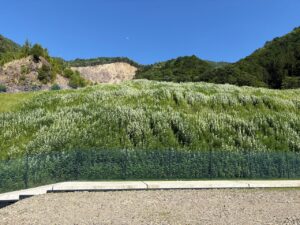
Construction Example of Maruhachi Doken: A landslide site in Mie Prefecture. While rocks and soil were fully exposed right after the collapse (visible in the background), the application of Poly-Soil Greening has stabilized the slope and stopped additional soil erosion.
— What about the cost?
Covering everything with concrete requires enormous costs, while measures like simply sowing seeds are cheap but leave concerns about stability. In that respect, Poly-Soil Greening is relatively inexpensive and has a proven track record, so we strongly recommend it.
Case Study of Poly-Soil Greening and Future Outlook
— Tell us about the recent project in Kyushu with Shizen Operations.
The owner of the solar power plant was struggling with major sediment runoff. Although they had built drainage channels, they weren’t functioning correctly; water was flowing down the slopes, leaving the land a wasteland where grass couldn’t take root. The soil was volcanic, sandy, and gravelly, and the area saw heavy rainfall. Local residents and farmers had also raised complaints.
When we investigated the site, the surface was not protected against erosion and was in a state susceptible to erosion. We applied Poly-Soil Greening and improved the water flow with transverse drainage channels.
The owner also requested that we “keep the solar panels clean” to avoid affecting power generation efficiency. Thanks to “low-pressure spraying,” which is one of the features of Poly-Soil Greening, we were able to work at our standard speed of 3,000 square meters per day without getting any residue on the panels.
The owner told us that this ability to work without dirtying the panels, combined with our 1,000-hectare track record, was the deciding factor.
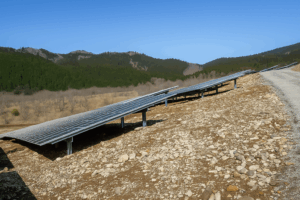
Before greening: Soil and gravel were exposed on the mountain surface, allowing rainwater to flow freely down the slopes.
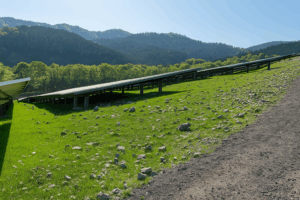 After greening: The vegetation has successfully prevented sediment runoff. Additionally, improvements to the drainage system ensure that water is now managed and discharged appropriately.
— What was the owner’s feedback after greening?
To put it simply, the owner was “extremely satisfied.” The completion inspection was conducted with local municipal officials, and even the ward head—who had been worried about local complaints—was fully convinced.
We’ve confirmed that the vegetation survived the winter well and should begin germinating in March. Interestingly, we didn’t see any soil freezing where the plants had taken root. Usually, freeze-thaw cycles make soil loose and increase the risk of turbid water, but the greening effectively prevented this.
— Do you feel that greening for solar plants is becoming more popular?
We get many repeat inquiries from owners and EPC contractors. However, even though we are registered with the New Technology Information System (NETIS), managed by the Ministry of Land, Infrastructure, Transport and Tourism, the general response hasn’t been as large as I expected.
There are still many operators who need this, but awareness of greening’s efficacy hasn’t spread enough. We often hear from clients, “I wish I’d known about this sooner,” so we want to work harder to popularize this method.
— Shizen Operations will continue to raise awareness about the necessity of civil engineering maintenance, including greening, with initiatives like seminars. Thank you for your time.
For detailed case studies and performance data on Poly-Soil Greening, please contact Shizen Operations.