Civil Engineering Risks Facing Solar Plants After 10 Years of Operation: The Importance of Inspection and Repair
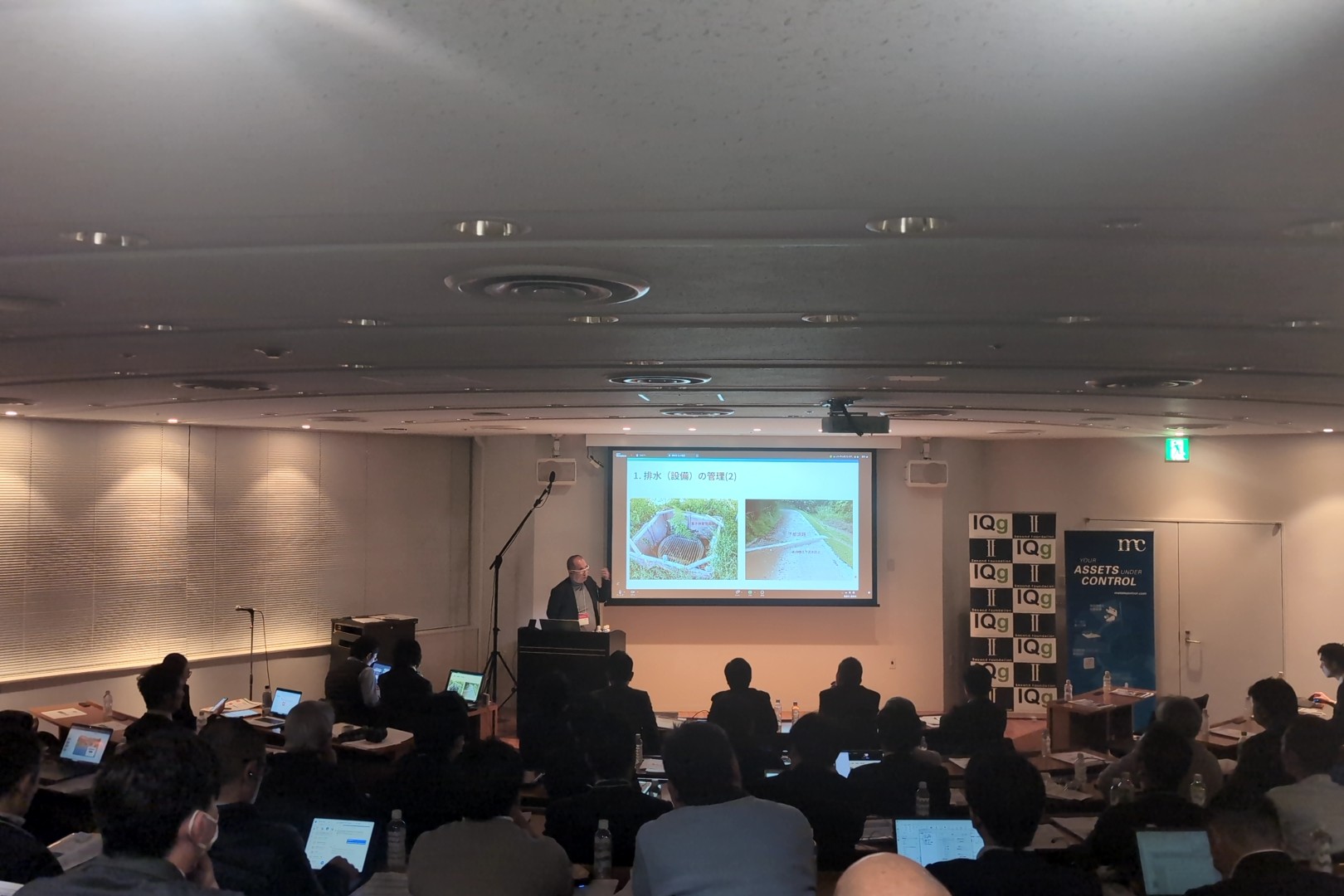
In January 2025, the 32nd PV Business Seminar was held in Akihabara, Tokyo. The seminar aims to introduce and share the latest technology trends and business models to expand the adoption of renewable energy.
As Japan faces the urgent need to significantly raise its renewable energy targets for fiscal year 2040, the seminar featured critical, multifaceted topics such as expanding the use of battery storage, trends in solar panel mandates, and solar plant O&M.
Representing Shizen Operations, Inc., Shoji Kadonaka, a senior engineer from the Engineering Department’s Construction Group, presented on the theme: “An O&M Engineer’s Guide to Civil Inspections for Operators Approaching 10 Years of Operation.”
With many solar power plants approaching their 10-year mark, seminars on civil engineering topics are emerging, reflecting a rise in industry concern. This report outlines the key points from our presentation.
A Surge in Decade-Old Plants | The Growing Demand for Civil Inspections
Approximately 13 years have passed since the feed-in tariff (FIT) program started in 2012. Today, power plants with over 10 years of operation account for more than 40% of the total.
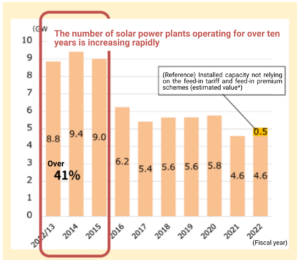
Source: 資源エネルギー庁「再生可能エネルギーの導入状況(2024年6月13日)」
For these plants to continue operating reliably, regular inspections are essential.
However, while electrical and communications equipment is inspected routinely, civil engineering infrastructure is often only addressed after a problem occurs.
The key takeaway here is the importance of preventive maintenance for civil engineering. From a cost perspective, early inspection and repair is less burdensome than post-incident restoration – a crucial point for asset owners.
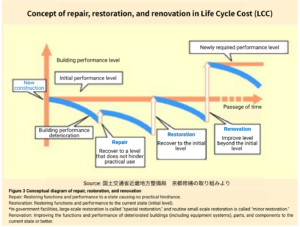
This diagram illustrates the concepts of maintenance (Corrective, Major and Upgrade) in relation to Life Cycle Cost (LCC). It shows that maintaining facility performance requires regular inspections and Corrective Maintenance, followed by Major Repairs after a certain period, and eventually Upgrades to upgrade performance levels.
The immediate priority is to maintain performance levels through routine inspections and Corrective Maintenance as needed.
Intensifying Weather, Growing Social Responsibility
As many solar power plants reach the 10-year mark, operators must continue to maintain safe and secure facilities.
Recently, however, Japan’s weather patterns have changed significantly, with record-breaking heavy rains and typhoons creating conditions that exceed original construction assumptions. When combined with the age-related deterioration of structures and equipment, this creates various risks.
Furthermore, government policy calls for doubling the current ratio of renewable energy by 2040. While expectations for solar power are high, associated problems and challenges are also drawing scrutiny.
In any case, inspection and repair at the current stage is undoubtedly the key to ensuring continued, stable operation post-FIT.
Civil Engineering Risks Surrounding Power Plants
Civil engineering risks at power plants are broadly categorized into the following three areas:
- Ground-related: Subsidence and collapse risk
- Muddy water issues: Impact on the surrounding environment
- Rack integrity: Long-term durability
Water and sediment runoff are particularly critical, as it has a major impact on neighboring areas and can determine the plant’s operational viability.
NEDO Guidelines and Maintenance Points
The following are the “Key Points for Civil Engineering Maintenance” presented in the guidelines from NEDO (New Energy and Industrial Technology Development Organization).
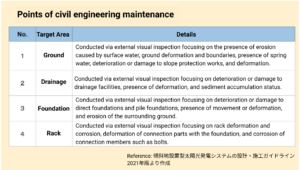
As the countermeasures indicate, the key terms are distress and deformation. If visual inspections of the ground or drainage reveal distress or deformation, it is a sign that corrective maintenance should be considered.
In the seminar, Kadonaka used field photography to explain the reality of civil engineering risks at solar power plants. We will highlight a few of these examples.
Risks Related to Drainage Facilities
First, let’s look at the area around drainage equipment.
■ Progressive Scouring and the Generation of Muddy Water and Sediment
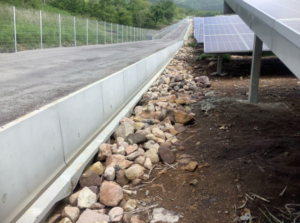
Scouring has prevented water from flowing into the U-shaped culvert, leading to further erosion. As a result, muddy water and sediment are flowing downstream.
■ Slope Collapse Due to Hydraulic Jumps
Water resists sharp changes in flow direction. In drainage channels with horizontal or vertical alignments, hydraulic jumps and poor conveyance occur. In the photo, this resulted in the collapse of the slope on the right side.
Considering data from the Japan Meteorological Agency showing the frequency of heavy rain is 1.4 times higher than a decade ago, there are concerns about whether the original design is reliable or suitable for current conditions.
In other cases, changes in water flow caused by cut grass or rain rills prevent drainage structures from functioning adequately.
As these examples show, drainage structures are not only failing to perform their intended role but are causing damage to the surrounding environment, including muddy water, sediment runoff, and slope collapse.
Risks Related to Environmental Changes
Next are risks related to environmental changes.
■ Risk of Fallen Trees on Transmission Lines
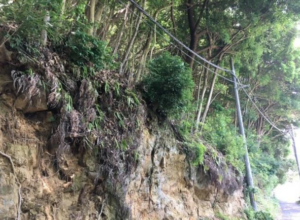
The ground has eroded, creating a very high risk of fallen trees hitting the transmission line. As this is an extra high voltage transmission line, any damage would result in massive power sale losses, requiring urgent repairs.
Risks Related to Muddy Water and Sediment
Risks related to muddy water and sediment also require close attention.
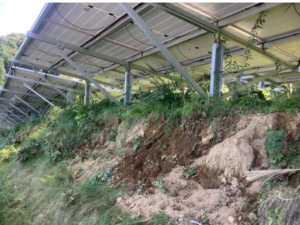
■ Scouring Under Solar Modules and Insufficient Greening
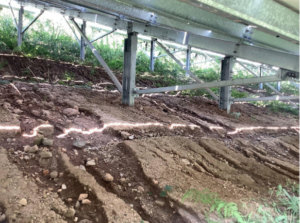
■ Slope Collapse
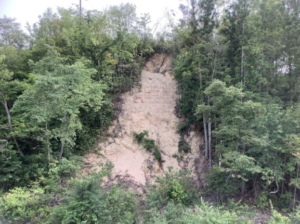
Both cases cause sediment and muddy water runoff.
The “Act on Regulation of Embankments” (Morido Kisei Act), which took effect on April 1, 2024, imposes stricter handling of sediment in sediment basins and retention ponds. We recommend taking preventive action if any risk is perceived.
Risks Related to Racks
The racks supporting the solar modules also face risks of toppling or corrosion due to aging.
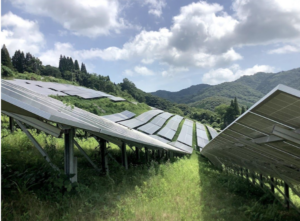
■ Risk of Foundation Pile Toppling Due to Distress in Pile Foundation Ground
If rack integrity is not verified and repaired as needed at the 10-year mark, some structures may not last until the end of the feed-in tariff period. Conversely, repairing them now can extend the life of the racks.
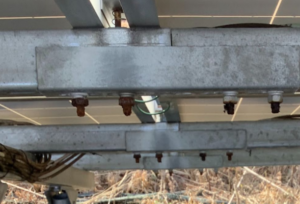
While distress primarily occurs in the foundation ground, steel corrosion is now visible at some power plants. Inspections are recommended, as there are risks of reduced power generation due to array degradation and debris scattering.
■ Corrosion at Connections
The Importance of Greening: Reducing Risk and Increasing Generation Efficiency
Greening work is effective in preventing muddy water and suppressing temperature increases behind panels. While greening alone is not a complete solution, it is crucial. In forest development projects, some authorities will not pass the final inspection unless greening is complete.
However, caution is required, as leaving leftover grass clippings or insufficient weeding around drainage structures can cause distress.
Finally, we introduce a case study of greening work by Shizen Operations Inc.
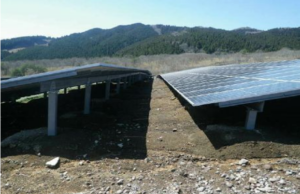
This site had issues with muddy water and sediment discharge. Due to cobble and gravelly soil property, conventional vegetation methods were not viable.
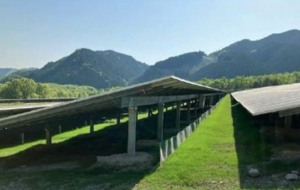
We implemented a solution using a special, non-scattering vegetation material. The results were highly successful, satisfying the operator as well as the local community and authorities.
■ Before (Shizen Operations Case Study)
■ After (Shizen Operations Case Study)
Greening requires consideration of many factors: civil engineering aspects such as soil properties, topography, and water flow, as well as the local climate and available plant species.
Conclusion
As many solar power plants reach their 10th year FIT milestone, expectations for renewable energy are higher than ever.
At the same time, age-related degradation of equipment and environmental changes inside and outside the plant, as introduced in this report, are progressing. Operators are now responsible for managing risks not only within their facilities but also in the surrounding communities.
To continue stable operation after the feed-in tariff period, inspection and repair is essential now.
Shizen Operations Inc. offers a free disaster prevention patrol separate from routine electrical O&M. We identify civil engineering risks to prevent damage and losses, and propose preventive and corrective measures. Please feel free to contact us.
Source:
電線素材、銅からアルミに 銅高騰で盗難防止ニーズ|日本経済新聞
LME Copper | London Metal Exchange
LME Aluminium | London Metal Exchange