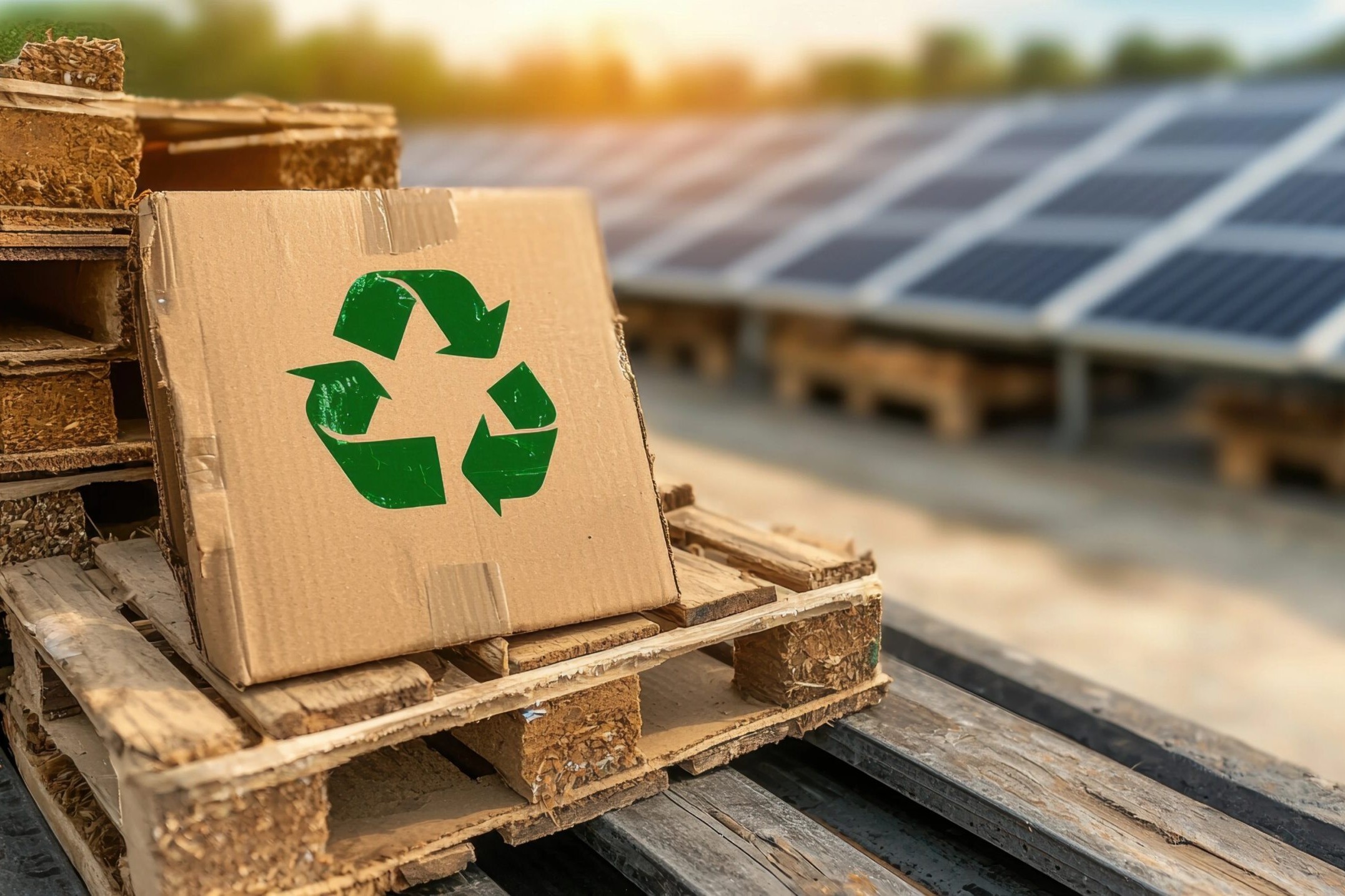
Solar power generation has become a dominant force in renewable energy. However, as installations reach the 20 to 30-year mark, the industry faces a looming challenge: a surge in used panels (End-of-Life panels).
Given this situation, there is growing interest in how solar panels are recycled and disposed of, as well as the challenges hidden within that process.
This article outlines the actual procedures for processing EOL panels, explains the technical and economic issues facing recycling facilities, and discusses the potential risk of unregulated export of reused panels.
Overview and the flow of EOL Panel Processing
The following chart illustrates the workflow for processing unwanted modules.
▼ Step-by-step breakdown of of EOL panel treatment
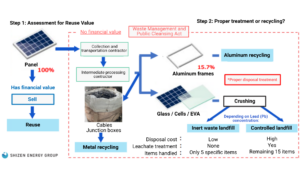
Reference: 太陽光発電設備の廃棄・リサイクル制度の論点について
Based on this workflow, here is a step-by-step explanation of how decommissioned panels are processed.
Step 1: Assessment of Reuse Value
When a panel is removed, the first step is to judge its economic value. If a panel is deemed to have value, it is sold for Reuse. For example, a module that has scratches on its backsheet but retains power generating capacity has market value and falls into this category.
On the other hand, modules that have reduced performance due to cracked surface glass or deformation are deemed to have no financial value. Only then are they considered End-Of-Life Panels and processed in accordance with the Waste Management and Public Cleansing Act in the next step.
Step 2: Maximize Recycling
In the second step, each component of the EOL panel is recycled to the fullest extent possible.
EOL panels determined valueless in the first step are subject to the Waste Management and Public Cleansing Act. They are defined as industrial waste, and they are entrusted to licensed collection and transportation contractors and intermediate processing contractors. While proper treatment proceeds under the same act, the process prioritizes resource recovery in accordance with the Basic Act on Establishing a Sound Material-Cycle Society.
First, cables and junction boxes are removed and sent to metal recycling.
Next, aluminum frames are removed and sent to aluminum recycling.
Step 3: The Remainder Goes to Controlled Landfill
The remaining glass/cells/EVA, which are difficult to recycle, undergo crushing treatment and are then disposed of at a controlled landfill. The destination depends on the concentration of lead (Pb).
Those with high lead concentration are sent to a controlled landfill, and those with low lead concentration are sent to an inert waste landfill.
A controlled landfill is equipped with water shielding and leachate control to prevent contamination of groundwater and water quality by leachate from landfilled waste. This ensures that hazardous substances like lead do not leak to the environment, providing a secure disposal method.
Barriers in EOL Panel Recycling
There are three primary barriers to recycling end-of-life panels:
- Glass separation
- Glass reuse
- Higher cost compared to proper treatment
1. Glass Separation
A major technological and cost hurdle is the clean separation of glass from the module laminate.
Currently, methods include 1) cutting, 2) thermal treatment, and 3) crushing. Here, we focus on the first two techniques:
▼ List of Glass Separation Methods
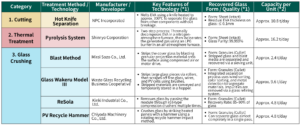
Reference: 太陽光発電設備の廃棄・リサイクル制度の論点について|経済産業省・環境省
Cutting: Hot Knife Method
Hot knife treatment is a method of inserting a heated blade (hot knife) into the bonding surface between the cover glass and resin to separate them.
Advantages:
・Can separate glass without crushing it.
Disadvantages:
・High cost per panel (time-consuming).
・Possibility of silver/lead electrode adhesion, making glass quality unstable.
Thermal Treatment: Thermal Decomposition Method (Glass “Wakeru” Separator Type III)
The thermal decomposition method separates and recovers resin and other components by thermally decomposing glass at high temperatures.
Advantages:
・Can separate by breaking only the glass without damaging silicon cells.
・High demand expected for use as recycled glass sand in construction.
Disadvantages:
・Takes time to process per sheet.
2. Glass Reuse
While the direct reuse of glass recovered from EOL panels would be ideal, the industry currently faces a lack of significant demand from glass manufacturers.
Furthermore, while a certain level of quality is required to reuse it as glass, removing the aforementioned silver/lead electrodes requires substantial costs.
Therefore, the current mainstream approach is utilizing it for secondary glass products such as roadbed materials and glass wool rather than reusing it as glass in its original form.
3. Higher Cost Compared to Proper Treatment
A further challenge is the cost disparity: recycling expenses currently exceed the cost of standard proper disposal.
The following table illustrates the price difference by processing method, based on Shizen Operations’ case studies.
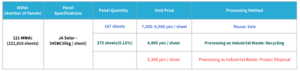
As shown, recycling an End-of-life panel costs 4,400 JPY per panel, whereas proper treatment (disposal) costs 3,300 JPY per panel, making it approximately 1,100 JPY cheaper to dispose of.
Similar trends have been reported by the Ministry of Economy, Trade and Industry and the Japan Photovoltaic Energy Association (JPEA).
- Processing as Industrial Waste (Recycling) Approximately 3,000 JPY/panel (Weight: approx. 20 kg)
- Processing as Industrial Waste(Proper Treatment) Approximately 2,000 JPY/panel (Weight: approx. 20 kg)
Reference: 太陽光発電設備の廃棄・リサイクル制度の論点について
Risks of Reuse Panels Flowing Overseas
In this section, we explain the risks associated with reuse panels flowing to overseas markets.
First, the current situation in Japan sees an increase in the number of companies purchasing well-maintained EOL panels, and the industry holds growth potential. At Shizen Operations, we resell purchased reuse panels with a warranty of up to three years, but our future challenge is to improve performance evaluation methods to further extend the warranty period.
On the other hand, there are companies that accept purchases but do not disclose the destination of use. It is advisable to avoid commissioning to such companies where proper reuse cannot be expected for the reasons introduced below.
Potential for Inappropriate Disposal Abroad
Domestically, proper treatment is conducted in accordance with the Waste Management and Public Cleansing Act. However, if panels flow overseas through such companies, they may end up being processed improperly with no means of tracking the outcome.
Specifically, similar to problem cases with electronic waste and used plastics, separation work may be performed at low wages where only aluminum is recovered, and the remaining parts are left as residue.
For these reasons, when EOL panels are generated, it is crucial to select companies that comply with laws and perform proper treatment.
Conclusion
There are several barriers to the disposal and recycling of solar panels, such as glass separation, difficulty of reuse, and processing costs. Furthermore, failing to establish a domestic disposal system heightens the risk of environmental pollution from inappropriate processing overseas.
To address the increasing volume of EOL panels, the selection of trustworthy, compliant operators is essential, in addition to advancing processing technologies and establishing reuse routes. Companies and individuals are called upon to face these issues and contribute to the realization of a sustainable energy society.
This is a challenge not only for Japan but also for the wider world. Shizen Operations intends to tackle this by staying abreast of the complexities regarding the proper treatment, and by driving initiatives and insight sharing grounded in accurate knowledge.